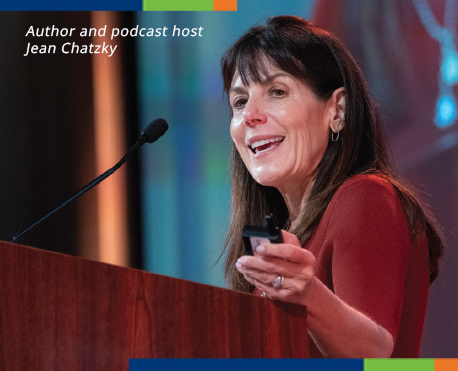
Reaching your financial goals takes resilience. During the Fraternal Celebration last September, that was just one of the valuable insights shared by Jean Chatzky, bestselling author and host of the HerMoney podcast. Here’s more of Chatzky’s guidance to help you stay on track for a confident retirement.
It’s important to make financial decisions that are right for you. That might mean keeping more cash in the bank so you can sleep easier at night, working a few more years to maximize Social Security or purchasing an annuity to ensure a steady income for the rest of your life. Whatever choices you make, the key is to be thoughtful and stick to your plan.
Behavioral finance uncovers how psychology influences financial decisions—often in surprising and irrational ways. For instance, people tend to rush to buy a lottery ticket as the jackpot grows and the odds of being the sole winner shrink. Another insight explains why people struggle to save for the future. It turns out we feel disconnected from our future selves, making us less motivated to save. Having a financial plan can help us avoid irrational choices and make smarter financial decisions.
A recent study of baby boomers revealed that they are more fearful of outliving their money than of dying. More than half of all Americans have never even tried to calculate how much money they will need for retirement. It’s easy to tell yourself that everything will be OK , but that can be dangerous. Creating a financial plan is the best way to ensure future financial stability.
Instead of crossing your fingers and hoping for the best, consider these two questions: 1) How long will you live? and 2) How long will you keep working? In the past three decades, life expectancy rates for men in this country have jumped from 70 to 76, and for women from 77 to 81. It turns out that the longer you live, the longer you’re likely to live. The average 65-year-old will live to about 84 years old. And half of those 65-yearolds will live beyond 84 years old! The general rule is to replace 70–80% of your pre-retirement income. Whether that’s enough depends on your personal goals. If you want to travel around the world or start a new business, you might need more. The key point is, when you consider these two questions and establish a plan, you’re more likely to achieve your financial goals.
To move forward financially, you must understand where you are right now, which means knowing how much money is coming in and going out. You’ve probably heard the saying, “What gets measured gets managed.” It’s true—when we track our finances, we’re likely to improve in reaching our goals.
The generation of the Great Depression saved money consistently. The personal savings rate in this country spiked in the 1940s and slowed a bit in the ‘50s and the ‘60s. Even in the mid-’80s, we were still saving 10% of whatever we made in this country. But by 2005, we spent more than we made. Today, the personal savings rate is only around 4%—indicating that few people are positioned to weather a financial emergency.
Emergencies are going to happen, which is why, despite low interest rates, your emergency fund should be kept in the bank because it needs to be stable and accessible. An emergency fund should cover three to six months of your annual income, at a minimum. But if you’re retired, you need at least two years worth of income.
The best way to rebuild an emergency fund is through automatic and recurring transfers. Why choose automatic? Because if you can’t see it or touch it, you won’t spend it. This is why saving in a retirement plan like a 401(k) works so well—the money never lands in your checking account.
Having a financial advisor as a sounding board is always beneficial. They serve not just as a portfolio manager but also as a therapist—someone who reminds you of essential things, like factoring charitable giving into your annual budget and keeping your priorities at the forefront.
Ultimately, your financial plan is about helping you achieve what you value most and recognizing that money is a tool to help you get the most out of life.